
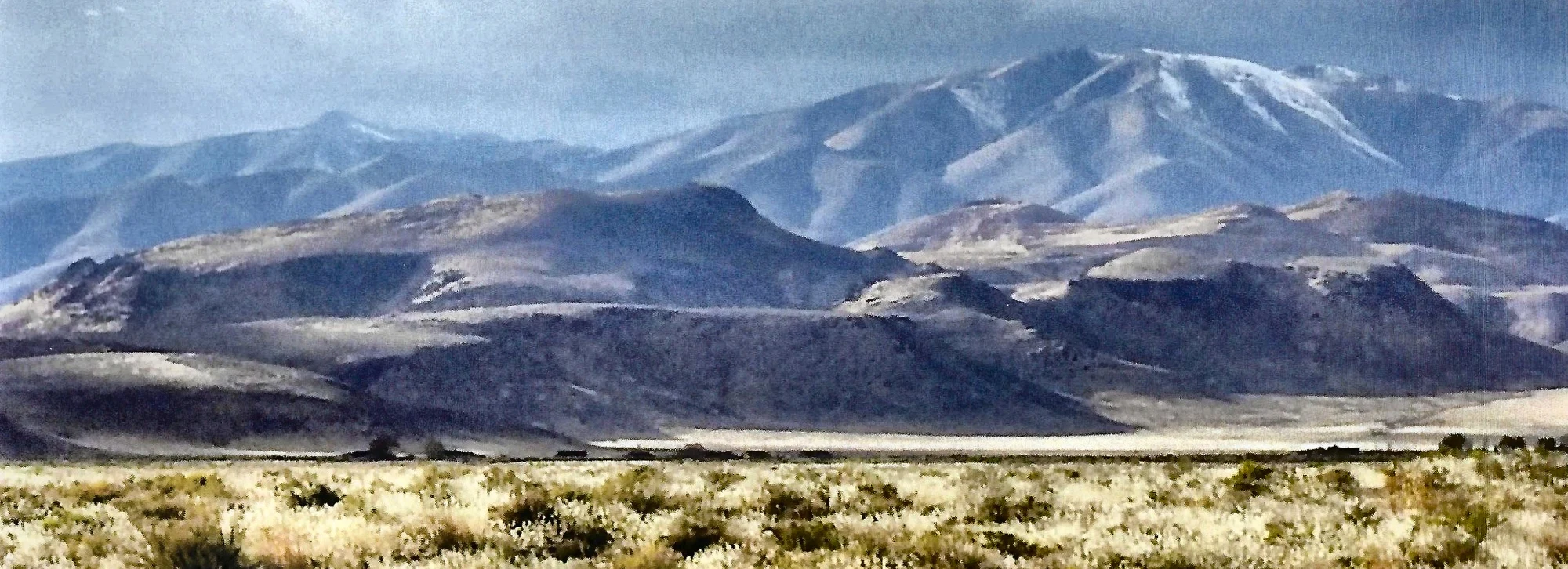
The landscape around Battle Mountain tells a story far older than towns, railroads, or mines.
Located within the heart of the Great Basin, Lander County is defined by wide valleys, isolated mountain ranges, and long horizons shaped by time and tectonics. The natural setting dictated where people could travel, settle, and survive, making geography the first architect of Battle Mountain’s history.
The region’s geology is the product of immense forces. Over millions of years, the Earth’s crust stretched and fractured, creating the classic basin-and-range pattern that defines Nevada. Ancient volcanic activity, faulting, and erosion exposed mineral-rich rock layers, concentrating copper, gold, silver, and other metals in places like Copper Canyon and the surrounding hills. These geologic processes explain why mining developed where it did—and why this area became one of Nevada’s most productive mineral zones.
Water has always been the most precious resource in this desert. The Humboldt River, flowing west across northern Nevada, is the only major river entirely contained within the state. For thousands of years, it has served as a lifeline—supporting wildlife, sustaining Indigenous communities, and later guiding emigrants, railroads, ranchers, and towns.
Sagebrush steppe dominated the valleys, providing habitat for pronghorn, mule deer, sage grouse, and countless smaller species. In the uplands, pinyon-juniper woodlands offered pine nuts, fuel, and shelter, while trout-filled streams supported wildlife. Peaks such as Mount Tenabo served not only as landmarks but as ecological enhancers, capturing snow and moisture that fed the surrounding basins.
Even today, the landscape retains its defining influence. The same open space that once guided Indigenous migration and westward travel now frames modern life in Battle Mountain. Mining still follows geologic logic. Ranching depends on the rhythms of grass, water, and weather. Trails—whether wagon roads, rail lines, highways, or bike paths—continue to follow routes set by the land itself.
Lander County’s history is inseparable from its landscape.
